

The Story
She was only twelve years old when the American Revolution came to her doorstep.
Phebe Brinkerhoff's world is filled with family, faith, and the quiet rhythms of life in New York’s Hudson Valley—until revolution changes everything. As British forces draw near and a fragile new nation struggles to be born, childhood gives way to hardship, responsibility, and unexpected courage.
Through Phebe’s eyes, readers experience the American Revolution not from the battlefield, but from the homes, farms, and villages where ordinary families endured extraordinary times. She helps care for loved ones, sews uniforms for Continental soldiers, witnesses fear and sacrifice, and discovers that history is shaped not only by those who fight wars, but also by those who keep hope alive.
Inspired by the documented life of a real young woman and enriched with meticulous historical research, Phebe’s War weaves authentic events into a deeply moving coming-of-age story. Along the way, Phebe’s family crosses paths with figures whose names would become part of American history, including George Washington and the Marquis de Lafayette—reminding us that the birth of a nation unfolded not only in halls of government and military camps, but also in ordinary homes like hers.
As America marks its 250th anniversary, Phebe’s War offers a fresh and deeply personal perspective on the Revolution through the eyes of a girl whose resilience, compassion, and determination reflect the spirit of a nation finding its identity.
Rich in historical detail and emotional depth, Phebe’s War is perfect for readers who love historical coming-of-age fiction, immersive Revolutionary War novels, and unforgettable stories inspired by real lives.
Some heroes changed history on the battlefield.
Others simply lived through it...and were changed forever.


The Inspiration
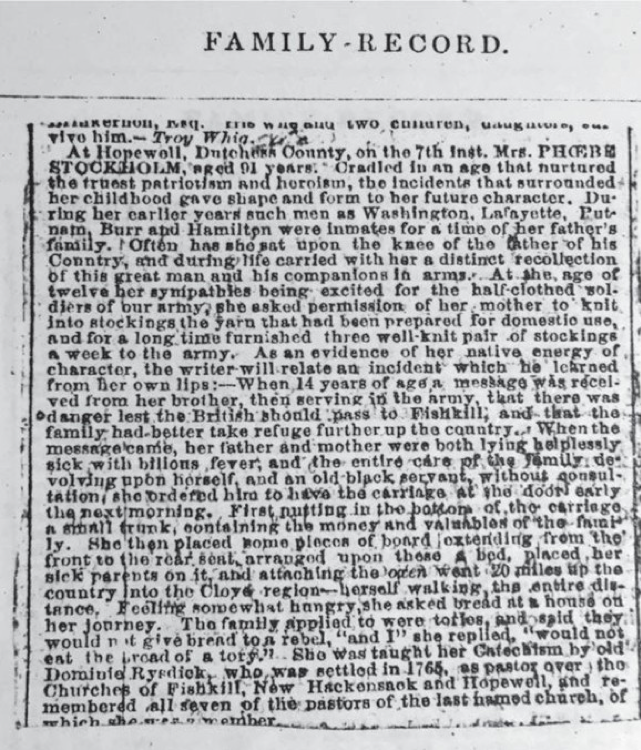
When the author, Michael Coudreaut, was seven, he moved in with his grandmother, a former high school history teacher whose own life had been limited by heart failure. One day, she lifted the lid of her small desk and carefully removed a fragile, yellowed newspaper clipping she had kept tucked inside an old family Bible. Through a magnifying glass, she shared with him this 1855 obituary of their ancestor, Phebe Brinkerhoff Stockholm — a woman who had sat on George Washington’s knee as a child, knitted stockings for Revolutionary soldiers at age twelve, and, at fourteen, single-handedly led her fever-stricken parents to safety as British forces approached.
That faded clipping planted the seed that would one day grow into Phebe’s War (translation below).
FAMILY RECORD.
At Hopewell, Dutchess County, on the 7th inst. Mrs. PHEBE STOCKHOLM, aged 91 years. Cradled in an age that nurtured the truest patriotism and heroism, the incidents that surrounded her childhood gave shape and form to her future character. During her earlier years such men as Washington, Lafayette, Putnam, Burr and Hamilton were inmates for a time of her father's family. Often she has sat upon the knee of the father of his Country, and during life carried with her a distinct recollection of this great man and his companions in arms. At the age of twelve her sympathies being excited for the half-clothed soldiers of our army, she asked permission of her mother to knit into stockings the yarn that had been prepared for domestic use, and for a long time furnished three well-knit pair of stockings a week to the army. As an evidence of her native energy of character, the writer will relate an incident which he learned from her own lips: — When 14 years of age, a message was received from her brother, then serving in the army, that there was danger lest the British should pass to Fishkill; and that the family had better take refuge further up the country. When the message came, her father and mother were both lying helplessly sick with bilious fever; and the entire care of the family devolving upon herself, and an old black servant, without consultation, she ordered him to have the carriage at the door early the next morning. First putting in the bottom of the carriage a small trunk, containing the money and valuables of the family. She then placed some pieces of board extending from the front to the rear seat, arranged upon these a bed, placed her sick parents on it, and attaching the oxen went 20 miles up the country into the Clove region — herself walking the entire distance. Feeling somewhat hungry, she asked bread at a house on her journey. The family applied to were tories, and said they wouldn’t give bread to a rebel, “and I” she replied, “would not eat the bread of a tory.” She was taught her Catechism by old Dominie Rydick, who was settled in 1766, as pastor over the Churches of Fishkill, New Hackensack and Hopewell, and remembered all seven of the pastors of the last named church, of which she was a member.